Bill Gates wants to save some jobs just for humans—how prepared is India?
While Bill Gates recommends a human quota just for humans. India already has a 59.5% caste-based job quota. How does math play out?
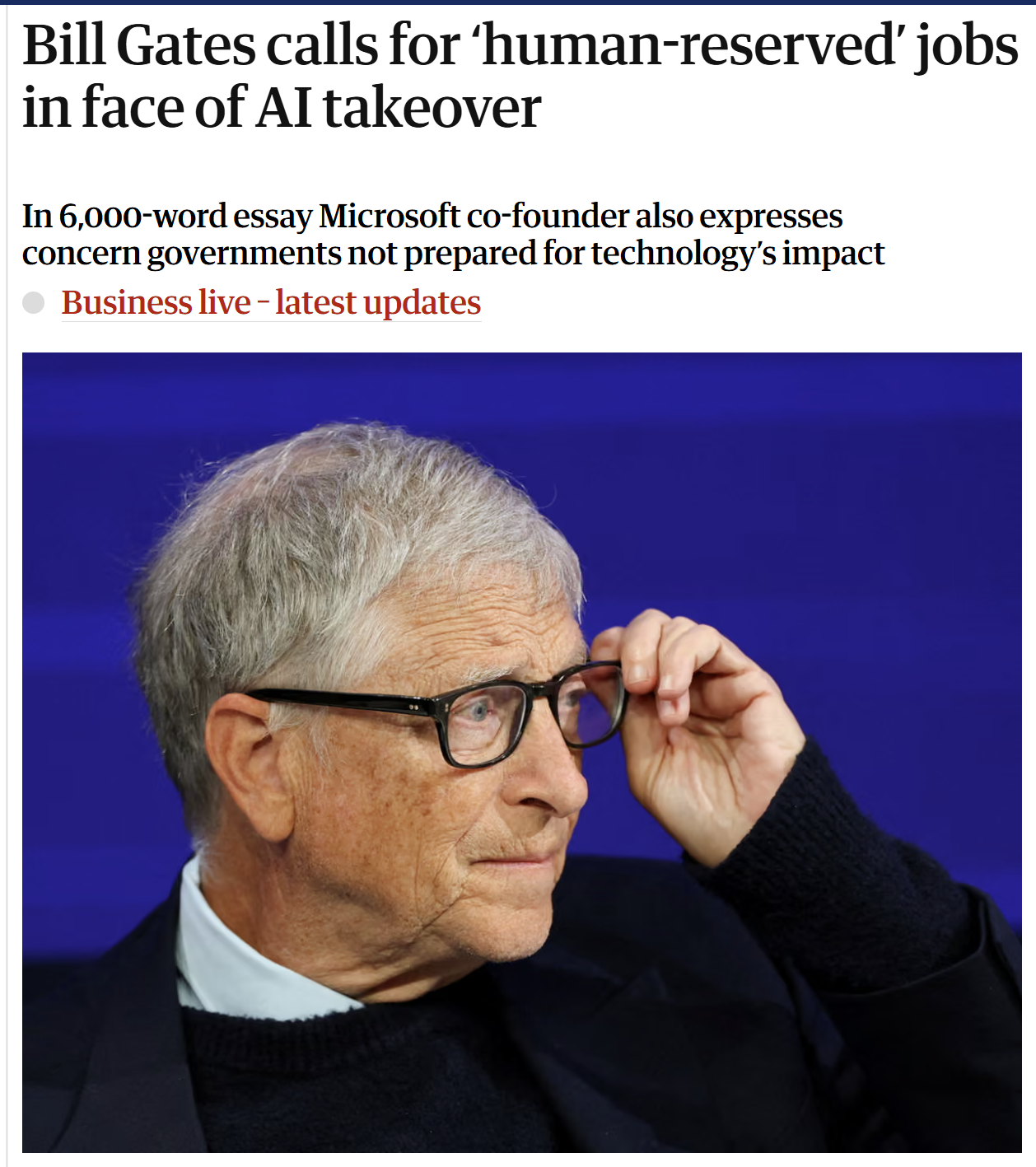
In August 2026, Bill Gates wrote a long article with a simple warning on the upcoming job situation.
No government is ready for what AI is about to do to jobs.
His idea is called “Human Reserved” jobs. These are roles—like childcare, jury duty, healthcare, and teaching—that stay human-only.
Even if AI could technically do them, he wants around 40% of jobs protected for humans this way.
“There is no plan to ease the entry into the AI era… we are not preparing for it.”
He put it bluntly. AI will either be “the greatest equalizer ever invented or the worst source of injustice.”
How about the rest of the jobs?
If you’re sitting in Seattle, that’s a policy idea. If you’re sitting in Greater Noida, it’s a collision waiting to happen.
India already has its own version of “jobs reserved for humans.” The caste-based reservations.
It exists for a completely different reason. Not to protect people from robots. It’s there to give fair representation to groups who were historically left out—based on caste and, to some extent, religion and region.
Now we’re about to have two different systems. Humans & Machines.
While one is trying to protect jobs that help run a family, there is another making sure the organization supporting human jobs is not left out.
Both are aiming at the same shrinking pile of seats.
Q1: Whose 40%?—Let's do the math India needs to do.
Disclaimer: To be fair, Gates’ 40% is meant for certain types of jobs, not just government jobs—so the two numbers aren’t exactly apples to apples, but still I am using government jobs as a reflection of the society we are trying to build.
In central government jobs, reservation already covers about 59.5% of all seats.
Quick decode:
OBC, SC, ST and EWS are the government categories that each get a fixed share of jobs — OBC gets 27%, SC gets 15%, ST gets 7.5%, and EWS gets 10%. Add them up and you get 59.5%.
That leaves less than half the jobs open to “General” hiring—meaning open to anyone, decided purely by exam score, with no category attached.
Now add Gates’ idea: say, 40% of jobs are protected just because a human should do them, no matter which category the person belongs to, but in India it is at 59.5%.
There is already an overshoot by 19.5%.
The open “General” pool seems more than disappeared if caste based reservation stays in India.
That would be a massive shift, and it seems very unlikely India is ready to push it through exactly like this.
Here’s a more realistic scenario. What if the “human reserved” 40% isn’t stacked on top of the existing 1,000 but is instead carved out of just the open General pool of 405 jobs (40.5%)?
Protect 40% of that open pool for humans only, and the truly unreserved, up-for-grabs pool shrinks to 60% of 40.5%—which is 24.3%, or about 243 jobs per 1,000.
Either way you run it—stacked on top or carved out of what’s left—the genuinely open pool shrinks to almost nothing.
So the question to ponder over is:
Does the AI-protection rule sit on top of the caste-based one? Does it replace it for some jobs?
Each answer builds a very different country.
This isn’t just a thought experiment. It’s already showing up in real numbers.
NITI Aayog is the Indian government’s own policy think tank.
In 2025, it estimated that AI could affect around 2 million jobs in India’s tech sector alone. That sector employs roughly 8 million people.
The same report said AI could also create 4 million new roles over five years—but only if India moves fast enough.
That’s not a prediction for USA. That’s India’s own government saying the clock is already running.
India’s reservation system was built to solve a problem from a different era with no expiry date. It was never designed to also handle a brand-new problem when not enough jobs are left that a machine can’t do cheaper and faster.
Q2: The politics and what happens if the government waits?
Let’s say if the government slows down its own AI upgrades, just to protect existing jobs a little longer, what happens to the economy while it waits?
If India spends all its energy arguing about who gets protected inside a shrinking job pool, instead of investing at the speed the AI race demands, we don’t just lose a few jobs.
We lose ground in the one race that decides whether India actually becomes the global economic power it wants to be.
Or it becomes a case study of how a big economy argued over reserved seats while other countries built real capability above and beyond holding on to the caste, religion, or region differences.
Piling the second problem on top of a structure built for the first one doesn’t protect more people. It just puts more weight on a system that was never built to carry it.
And it’s happening right when a much bigger, faster-moving force is at play, while the global AI race has not paused for India to sort out this internal debate.
I am sure very soon a few govt representatives might give a statement that we will continue to outsource nursing, plumbing, carpentry, etc.
Not that these jobs are small, but is this what as a country we will continue doing?
Q3: What happens to the tax revenue that the job used to pay
A large share of government tax revenue comes from income tax, deducted straight from people’s salaries every month, before the money even reaches their bank account.
Now picture that same job done by an AI agent instead.
The company doesn’t pay the AI agent a salary. It pays a software or compute bill. That bill sits on the books as a business expense, not as income going into anyone’s account.
No salary. No bank transfer to a person. No income tax getting deducted at source, the way it does for a human employee.
So here’s the real question.
As AI agents replace more human jobs, the tax base quietly shrinks in the background. That tax base is what pays for government reservation and every other government promise.
This isn’t a made-up worry.
MIT researchers studying automation found that every robot added in manufacturing replaced roughly 3.3 workers.
That’s exactly the kind of shift that quietly drains payroll-tax revenue over time. It’s also close to what Gates already proposed—taxing AI tokens and robots directly, precisely because the usual tax on salaries stops applying.
The 4S Lens: Different Scarcities and the Factors Affecting
Applying my 4S Model to all the observations under this article says every system sits in one of four states. That could be a person, a company, or a country.
The four states are: Survival, Superiority, Self-Attainment, or Spirituality. What decides which state you’re in?
And the Four factors— your Systems & Structure, your Culture, your Resources, and the External Factors happening around you.
A country in Survival mode builds rules to protect and divide up what already exists, because there isn’t enough to go around.
A country in Self-Attainment mode builds things to grow the pie instead, because it’s no longer just fighting over slices.
In 4S terms, while the reservation is a structural problem, the tax question hits the “Resources” factor head-on.
The same government trying to protect jobs through Systems & Structure is quietly watching its own resources—tax revenue—shrink. And it’s shrinking from the very technology it hasn’t figured out how to regulate yet (the external factor).
The same thing is true for people, not just countries.
Real security was never built by protecting a position.
It’s built by working on the core: the actual skill and ability underneath the position, the thing that gets you back on your feet even if you lose the seat.
Reservation, at its best, was meant to buy communities time to build that core, after being denied the chance for generations.
Gates is really forcing every government to ask the same question at a national scale.
Can this idea work for a whole country or an organization, not just one person?
A nation that spends the next ten years protecting positions instead of building the skill behind those positions will learn the same lesson a person eventually learns.
The position was never the real safety net.
The core was—the same argument I make in my book Mantras of a Happy Life, just applied here to a country instead of a career.
What do you think? Is this just another AI hype?
________________________________________________________________
References:
— Fox Business, “Bill Gates outlines the stakes of the AI era: ‘greatest equalizer’ or ‘worst source of injustice’”: https://www.foxbusiness.com/technology/bill-gates-outlines-stakes-ai-era-greatest-equalizer-worst-source-injustice
— SolidAITech, “Bill Gates on AI Risks: Human Reserved Jobs & Token Taxes”: https://www.solidaitech.com/2026/08/bill-gates-ai-warning-human-reserved-jobs.html
— eMarketer, “Gates vs. Schmidt: Big Tech titans clash on AI’s job takeover timeline”: https://www.emarketer.com/content/gates-schmidt-big-tech-titans-clash-ai-job-takeover-timeline
— The Guardian, “Bill Gates on human reserved jobs and the AI takeover” (Aug 26, 2026): https://www.theguardian.com/technology/2026/aug/26/bill-gates-human-reserved-jobs-ai-takeover
— iasgyan.in, “Reservation in Central Government Posts” (OBC 27% / SC 15% / ST 7.5% / EWS 10%): https://www.iasgyan.in/daily-current-affairs/reservation-in-central-government-posts
— Oxfam India, “A Glance at the Informal Sector in India”: https://www.oxfamindia.org/knowledgehub/factsheets/glance-informal-sector-india
— Business Standard, “AI impact may affect 2 million jobs in India’s tech sector: NITI Aayog”: https://www.business-standard.com/industry/news/ai-impact-may-affect-2-million-jobs-in-india-s-tech-sector-niti-aayog-125101100028_1.html
— MIT News, “How a ‘Robot Tax’ Could Reduce Income Inequality” (on automation and tax-base erosion): https://news.mit.edu/2022/robot-tax-income-inequality-1221
— Kumar, Kundan. *Mantras of a Happy Life*. Fingerprint Publishing, 2025.